18 Building a Small Data Platform
The earlier chapters treated one concept at a time. This chapter puts the pieces together in a project that is intentionally small enough to understand without a platform team, yet structured enough to behave like a platform rather than a folder of scripts.
The complete runnable project is in examples/insurance-platform/. It uses only local files and versioned RDS output, so it needs no database, object store, catalog service, or credentials. The book’s CI runs the example tests before rendering the book.
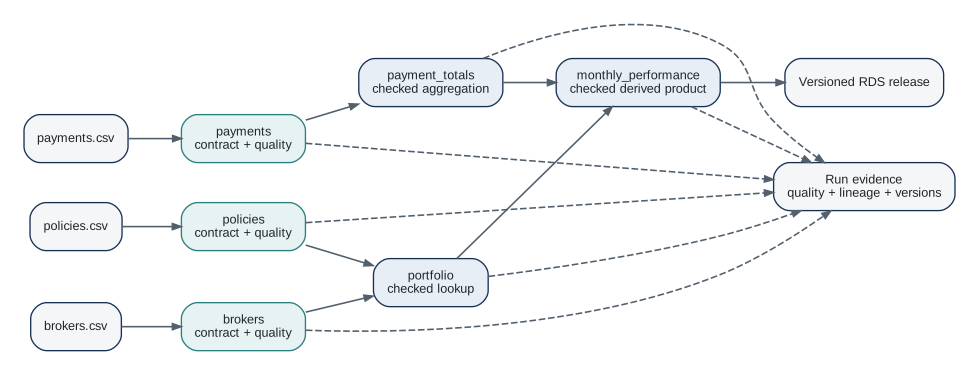
18.1 Start from product boundaries, not folders
The project contains three source deliveries:
policies.csv, one row per policy;brokers.csv, one row per broker;payments.csv, one row per payment event.
The first architectural decision is not where these files will be stored. It is what reusable products they represent and at what grain.
The project therefore defines six logical products:
| Product | Grain | Main responsibility |
|---|---|---|
policies |
one row per policy | policy interface and policy checks |
brokers |
one row per broker | broker reference data |
payments |
one row per payment event | payment event interface and checks |
portfolio |
one row per policy | policies enriched with broker region |
payment_totals |
one row per policy | payment events aggregated to policy grain |
monthly_performance |
one row per policy | portfolio joined to payment totals with an outstanding amount |
This table is more important than the directory tree. Once the grains are explicit, the joins and contracts have something stable to protect.
18.2 The project layout
examples/insurance-platform/
  R/
    products.R
  tests/testthat/
    test-platform.R
  releases/
  run.R
  README.md
The input fixtures remain in the book-level data/ directory so the same synthetic data can be used by earlier chapters.
The entire product graph is constructed by one function:
source("examples/insurance-platform/R/products.R")
products <- insurance_products(".")
Construction defines objects and source locations. The file sources are read only when a product executes. That distinction lets tests inspect and validate definitions without turning every constructor into an I/O operation.
18.3 Step 1: make the source products explicit
The policy product demonstrates the basic pattern used throughout the project. The contract carries identity and shape. Business metadata and validation policy are composed separately. Quality rules state acceptance decisions.
policies_contract <- dataraft::dr_contract(
  "policies",
  columns = c(
    policy_id = "integer",
    broker_id = "integer",
    premium = "numeric",
    status = "character"
  ),
  key = "policy_id"
) |>
  dataraft.core::dr_contract_meta(
    owner = "Risk Analytics",
    grain = "One row per policy"
  ) |>
  dataraft.core::dr_contract_policy(allow_extra = FALSE)
The source is a deferred file source rather than an eagerly loaded data frame:
policies_source <- dataraft.core::dr_source_file(
  "source.policies",
  "data/policies.csv",
  reader = utils::read.csv
)
The product then composes source, contract, and quality:
policies <- dataraft::dr_product("policies", policies_source) |>
  dataraft::dr_add_contract(policies_contract) |>
  dataraft::dr_add_quality(dataraft.core::dr_quality_rule(
    "premium_non_negative",
    ~ premium >= 0,
    action = "block"
  ))
brokers and payments follow the same pattern. This repetition is deliberate. Each source product has its own identity, grain, owner, and acceptance rules.
18.4 Step 2: change grain before joining
Payments are event data. Policies are entity data. Joining them directly would change the policy grain whenever a policy has multiple payments.
The platform therefore creates payment_totals first:
payment_totals_recipe <- dataraft.core::dr_recipe() |>
  dataraft.core::dr_step_summarise(
    paid = sum(amount),
    .by = policy_id
  )

payment_totals <- dataraft::dr_product("payment_totals", payments) |>
  dataraft::dr_add_contract(payment_totals_contract) |>
  dataraft.core::dr_add_recipe(payment_totals_recipe) |>
  dataraft::dr_add_quality(~ paid >= 0)
This is a small example of a general rule: make grain changes visible as product boundaries when consumers rely on the new grain. The aggregation is not merely an implementation detail. It changes what one row means.
18.5 Step 3: enrich policies without hiding the dependency
portfolio starts from the checked policies product and uses brokers as a named lookup dependency:
portfolio_recipe <- dataraft.core::dr_recipe() |>
  dataraft.core::dr_step_lookup(
    brokers,
    by = "broker_id",
    name = "brokers"
  )

portfolio <- dataraft::dr_product("portfolio", policies) |>
  dataraft::dr_add_contract(portfolio_contract) |>
  dataraft.core::dr_add_recipe(portfolio_recipe) |>
  dataraft::dr_add_quality(~ nzchar(region))
The result is still one row per policy. The contract states that region is now part of the product interface. The lookup is recorded as preparation rather than buried inside an anonymous script.
A common alternative is to load two tables at the top of a script and call left_join(). That may be completely appropriate for a one-off analysis. The product form becomes useful when the dependency and resulting interface need to survive beyond the script that created them.
18.6 Step 4: compose the final product
The final monthly_performance product uses portfolio as its main input and payment_totals as a lookup. A missing payment is permitted, because not every policy must have a payment event in the fixture. Missing totals are converted to zero before the outstanding amount is calculated.
performance_recipe <- dataraft.core::dr_recipe() |>
  dataraft.core::dr_step_lookup(
    payment_totals,
    by = "policy_id",
    name = "payment_totals",
    unmatched = "keep"
  ) |>
  dataraft.core::dr_step_mutate(
    paid = dplyr::coalesce(paid, 0),
    outstanding = premium - paid
  )
This recipe also demonstrates a useful lineage boundary. The current static column-lineage analyzer understands a conservative set of transformations. An expression such as dplyr::coalesce() can make static column lineage incomplete. DataRaft reports that incompleteness rather than guessing. Product-level dependency lineage remains meaningful even when static column-level evidence is partial.
18.7 Step 5: check before writing
The first complete run stays in memory:
checked <- dataraft::dr_run(
  products$monthly_performance,
  write = FALSE,
  stop_on_failure = FALSE
)

checked$status
dataraft::dr_quality_report(checked)
output <- dataraft::dr_collect(checked)
For the shipped fixtures the expected status is completed. If a contract or quality rule blocks the delivery, the result remains diagnostic evidence and dr_collect() will not treat it as accepted output.
This separation is the core safety property of the example. Writing is not the way you discover whether a delivery was valid. Validation and quality happen before a durable target is committed.
18.8 Step 6: add a governed durable output
The local example keeps RDS as the physical target, but publication now goes through a declared output port with an SLA. The logical product remains unchanged.
release_root <- "examples/insurance-platform/releases/monthly-performance"

publishable <- insurance_release_product(
  products,
  release_root
)

published <- dataraft::dr_publish(
  publishable,
  business_date = "2026-10-02"
)
The helper attaches an internal reporting_extract output port backed by the RDS target and a daily 09:00 UTC SLA. The product also carries a publish policy requiring owner metadata.
Each successful RDS write still creates a versioned local release. The additional controls answer different questions: did the product satisfy its publish policy, did the output port publish, and what does the SLA evidence say about delivery time?
A later move to dataraft.lake changes the physical release mechanism and adds registry, lifecycle, recovery, and integrity features. It does not require redefining what monthly_performance means.
18.9 Step 7: inspect product lineage
The root result records which product inputs contributed to monthly_performance.
lineage <- dataraft::dr_lineage(checked)
lineage
This is dataset-level evidence for the executed graph. It does not claim complete column or business lineage.
18.10 Step 8: test behavior, controls, and evidence
The companion project tests four concerns:
- the complete graph returns a checked
monthly_performanceresult and explicit lineage; - a negative policy premium is blocked before reuse;
- publication creates a readable RDS release and records policy, port, and SLA evidence;
- the executed root exposes a product-lineage edge into
monthly_performance.
These are deliberately different scales. The first proves composition, the second proves the acceptance boundary, the third proves governed publication, and the fourth proves that lineage is observable rather than only described in prose.
This follows the Posit testing guidance used in this project: keep tests self-contained, use temporary paths for side effects, and assert specific behavior rather than relying on one large end-to-end test (Posit 2026).
Run them from the book root with:
Rscript scripts/verify-examples.R18.11 What makes this platform-shaped?
Nothing in this chapter is large. There is no cluster, scheduler, data catalog, or cloud account. Yet the project already has platform-like properties:
- recurring deliveries have stable identities;
- row grain is explicit;
- producer expectations are executable;
- business checks determine acceptance;
- dependencies are visible as product relationships;
- storage is replaceable behind a target boundary;
- failures return diagnostic evidence;
- durable releases are versioned rather than silently overwritten;
- publication policy, output-port state, and SLA evidence are inspectable;
- product lineage is tested from the executed result;
- the same definitions are testable in CI.
That is enough to support a team more safely than a collection of unrelated scripts.
18.12 What to add next
Add infrastructure only when a concrete operating requirement appears.
Use dataraft.lake when shared release history, recovery, integrity verification, lifecycle state, or lake-backed access is needed. Use OpenMetadata or OpenLineage integration when the organization already has a metadata plane. Use output ports when one accepted delivery really needs multiple destinations. Use policies and SLAs when there is an actual organizational rule or delivery promise to enforce.
The next chapter tests the same product model against change. That is where contracts and explicit dependencies start to earn their cost.
Copy data/policies.csv, set one premium to -1, and point the policy source at the modified file. Predict which rule will fail and which downstream products will become unavailable before running the tests.
18.13 Exercises
- Add a
claimssource product at one row per claim. Decide whether the first reusable downstream product should stay at claim grain or aggregate to policy grain. - Replace the final RDS target with a temporary lake target if DuckDB is available. Keep the logical product definition unchanged and compare the resulting release evidence.
- Add a fourth test that asserts the final product grain remains one row per policy after all lookups.