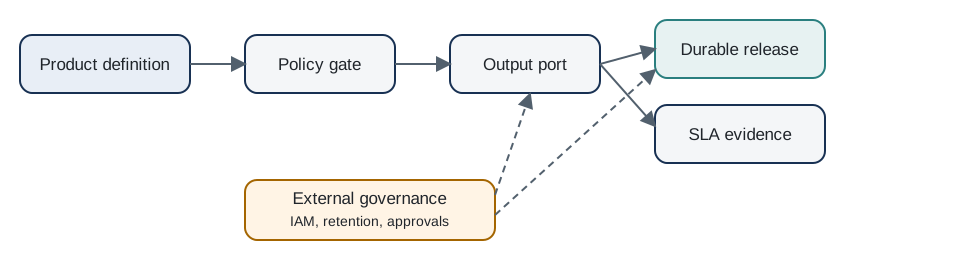
Governance becomes useful when it changes a decision at a product boundary. DataRaft implements several deliberately bounded controls rather than claiming to be a general enterprise policy engine.
Figure 14.1: DataRaft product governance flows from the definition through a policy gate and output port to a durable release, while SLA evidence and external controls remain distinct responsibilities.
# A tibble: 1 × 6
  id            version event   decision missing evaluated_at
  <chr>         <chr>   <chr>   <chr>    <chr>   <dttm>
1 require-owner 1       publish pass     ""      2026-10-26 11:37:14
The same mechanism can warn instead of block and can target selected classifications. Organization-wide policies can also be supplied through the dataraft.policies option.
This is a local product policy mechanism. It is not IAM, legal approval, or a replacement for a general authorization engine.
14.2 Ports describe product interfaces
dr_input() and dr_output() describe consumer-facing interfaces around a product.
An output port can carry a contract version, descriptive access classification, and an SLA. The access field is metadata, not an authorization grant.
Multiple outputs are written sequentially. They are explicitly not one distributed transaction. If a later destination fails after an earlier one commits, the result records partial publication and dr_retry_ports() can resume unpublished secondary outputs from the retained in-memory result.
Honest partial state is stronger than pretending heterogeneous systems share atomicity they do not provide.
14.3 SLA evidence is about delivery
The current SLA model supports daily and weekly delivery expectations.
# A tibble: 1 × 5
  business_date deadline            delivered_at        evaluated_at
  <date>        <dttm>              <dttm>              <dttm>
1 2026-10-02    2026-10-02 09:00:00 2026-10-02 08:30:00 2026-10-02 08:30:00
# ℹ 1 more variable: status <chr>
A quality check can pass while the delivery is late. That is why quality status and SLA status remain different evidence.
When an SLA is attached to an output port, publication requires an explicit business_date and records the evaluation in run metadata.
14.4 Durable lifecycle belongs to the lake
dataraft.lake adds persisted lifecycle operations such as promotion, deprecation, retirement, and backfill. A retired product cannot accept new lake releases.
This creates a layered governance model:
Layer
Responsibility
contract and quality
acceptance expectations
policy
bounded organization rule at a lifecycle event
port
declared consumer interface
SLA
delivery promise and evidence
lake lifecycle
persisted release and product state
external governance
IAM, legal controls, retention, approvals
The layers can work together without pretending one mechanism owns all governance.
14.5 Exercises
Remove the owner metadata from the executable example and inspect the policy decision.
Explain what should happen operationally if a primary output commits and a secondary output fails.
Evaluate the SLA with a delivery after 09:00. Why is that different from a failed quality rule?