A contract records what consumers may rely on. In DataRaft, the structural constructor is deliberately small: identity, columns, keys, rules, and version.
Supported audited column types include character, integer, numeric, logical, Date, POSIXct, integer64, and list.
A key is more than a useful name. It states that the declared field is part of row identity and must satisfy the key checks.
5.2 Add business meaning separately
policy_contract <- policy_contract |> dataraft.core::dr_contract_meta(owner ="Risk Analytics",description ="Policy portfolio used by the recurring reporting workflow",grain ="One row per policy" )
Metadata describes the product. It does not itself decide whether a delivery is accepted.
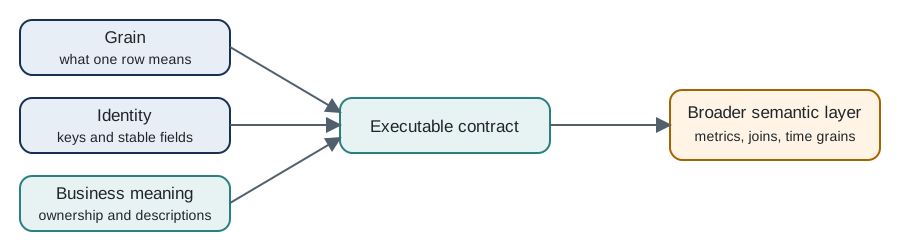
Figure 5.1: Grain, identity, and business meaning feed the executable contract, while broader cross-tool query semantics remain a separate integration boundary.
A schema says that premium is numeric. It does not say whether the value is annual premium, monthly premium, gross premium, or net premium.
For a reusable product, establish at least four semantic facts:
grain: what one row represents;
identity: which fields distinguish rows;
meaning: what important measures and categories represent;
ownership: who can decide whether that meaning changes.
DataRaft models part of this directly through keys and contract metadata. It does not try to become a complete enterprise semantic layer. Broader metric semantics, universal join rules, and cross-tool query semantics can remain in a dedicated semantic system.
The important design rule is that schema validation should not be mistaken for complete business meaning.
5.5 Contract evolution
Changing rows is not the same as changing the interface.
# A tibble: 2 × 4
  field                 before      after           breaking
  <chr>                 <chr>       <chr>           <lgl>
1 columns.sales_channel "null"      "\"character\"" TRUE
2 version               "\"1.0.0\"" "\"2.0.0\""     FALSE
A useful rule is:
new rows with the same meaning: new run, same contract version;
changed consumer expectation: new contract version;
changed storage location only: usually no contract change.
Compatibility remains a consumer question. Adding a field may be harmless for one consumer and breaking for another. Renaming a key or changing row grain deserves explicit downstream review.
TipDesign guidance
Put business meaning in metadata, stable structural expectations in the contract, and delivery-specific outcome checks in quality rules.
5.6 Exercises
Add sales_channel to a new contract version and explain whether existing consumers need to change.
Change the key from policy_id to two columns. What statement about row identity have you changed?
Write one semantic statement about premium that cannot be represented by its R type alone.